Over a Century of History
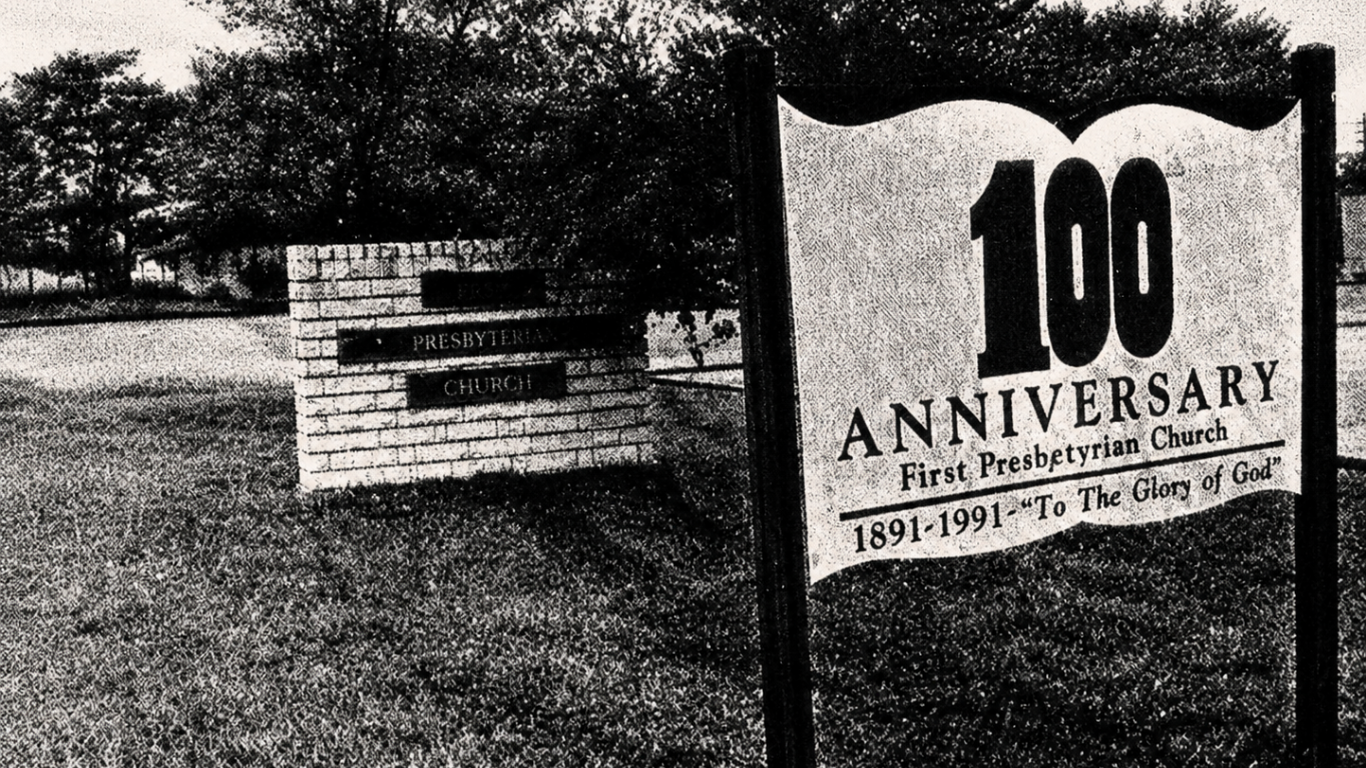
A handful of determined Presbyterians came together in a small South Texas town with a shared vision and an unshakeable faith. Today, that vision lives on. The history of First Presbyterian Church of Beeville is a testament to what a community can build when it works together "To the Glory of God."
Table of Contents
The Early Years
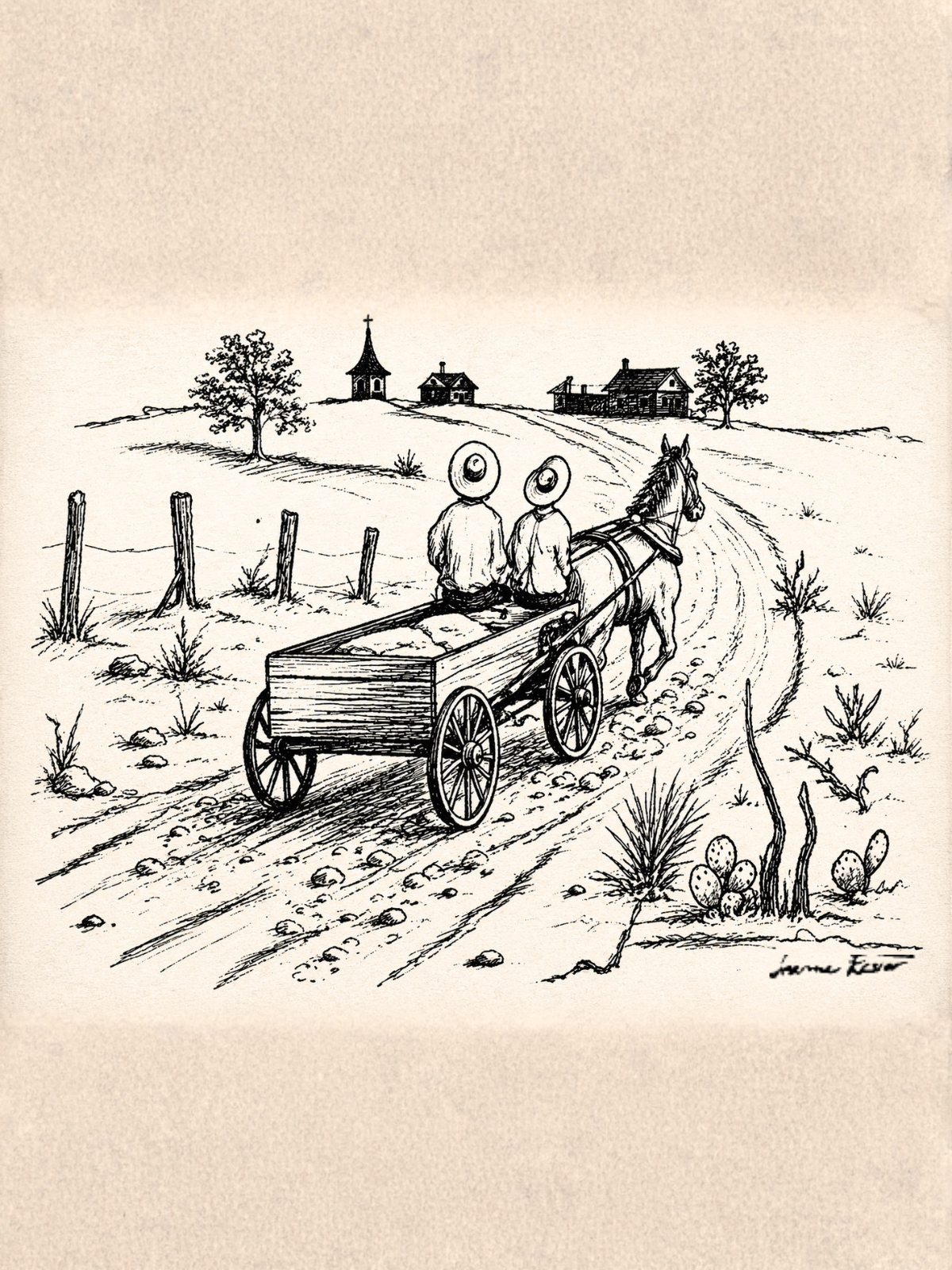
The history of the Presbyterian Church in Beeville began sometime back in 1885. A minister from nearby Corpus Christi, J. R. Howerton, came to Beeville, then a small town baked in the hot South Texas sun. A town, at the time, about the size of nearby Skidmore. His mission was to meet with people and study the prospect of forming a Presbyterian church in this small rural but energetic community.
He was able to gather a few, maybe five or six, ambitious people to show interest in forming a congregation. In name, Presbyterians who were enlisted in the Master’s service were John W. Flournoy, Mr. and Mrs. W. S. Dugat, Mrs. G. M. Irwin, and J. C. Beasley.
During this early period from 1885 until some point in 1890, church meetings were held at various locations. The old Methodist Church and the Opera House served as places of worship two Sundays each month, and prayer meetings were held on Tuesdays.
A Rev. J. R. Tames and Rev. Montgomery gave of their services in Beeville, Goliad and Rockport, as none of the communities had enough members to support a minister for the whole time. Another, Robert M. Hall, a student of Divinity, under Dr. Josephus Johnson of Victoria, also came to Beeville. These ministers were all engaged and sustained by Presbyterian Lawyers, John W. Flournoy, J. C. Beasley, and W. S. Dugat.
Because of the times, travel was slow and tedious. It became necessary for these ministers to stay overnight, sometimes longer, with local Beeville families.
Finally, in late 1890 and during the early part of '91, West Texas Presbytery sent a Rev. Henry R. Laird to Beeville. He was an Evangelist with faith, vigor, strong convictions, and dedication. It was this vibrant man's job to organize a church and establish it in the tiny community.
He arrived finding a town with hard, dusty streets that became very muddy when it rained, which was not often. Actually, the weather seemed fairly warm for this time of year. The population of the entire county was reported as three thousand seven hundred to thirty-nine hundred people.
Rev. Laird's instructions were simple enough. Despite his zeal, a great amount of time and much hard work lay ahead.
He knew that it would be a slow process, but after a time it became a pleasant and rewarding reality.
It has been written that visiting ministers during those early formulating years were Rev. J. W. Neil of San Antonio; Rev. A. H. P. McCurdy of Cuero; Rev. A. W. White of Corpus Christi; and Rev. Josephus Johnson of Victoria.
Church meetings were still held at other church facilities and, in addition, room was rented on the second floor of the H. P. Mathews furniture store, which served as Rev. Laird's reception room, bedroom, living room, kitchen, Sunday School and Evening worship.
At the time when the Presbyterian Church in Beeville was organized by West Texas Presbytery on October 29, 1891, there were twenty-six charter members. Fourteen men and twelve women.
Charter Members
A. G. Bardwell & Mrs. A. G. Bardwell
R. Garrett & Mrs. R. Garrett
William Haltz & Mrs. William Haltz
Max Brauer & Mrs. Max Brauer
G. W. McFadden & Mrs. G. W. McFadden
W. S. Dugat & Mrs. W. S. Dugat
Miss Estelle Dugat • Nannie Bardwell
Mrs. G. Garrison • Mrs. M. G. Irwin
Mrs. Harry Manning • Mrs. A. F. Rachal
Miss Annie Meinrath • Lottie Bickford
Dr. Findley • J. C. Beasley
John W. Flournoy • E. B. Skaggs
J. C. Crisp • G. M. Magill
During one of the church meetings, they determined it was time to select Elders and Deacons. The first church Elders were W. S. Dugat, A. G. Bardwell and J. C. Crisp. Two Deacons were named: G. W. McFadden and G. W. Magill.
A few months later, the Bardwell family moved, and A. G. Bardwell was replaced as an Elder by John W. Flournoy.
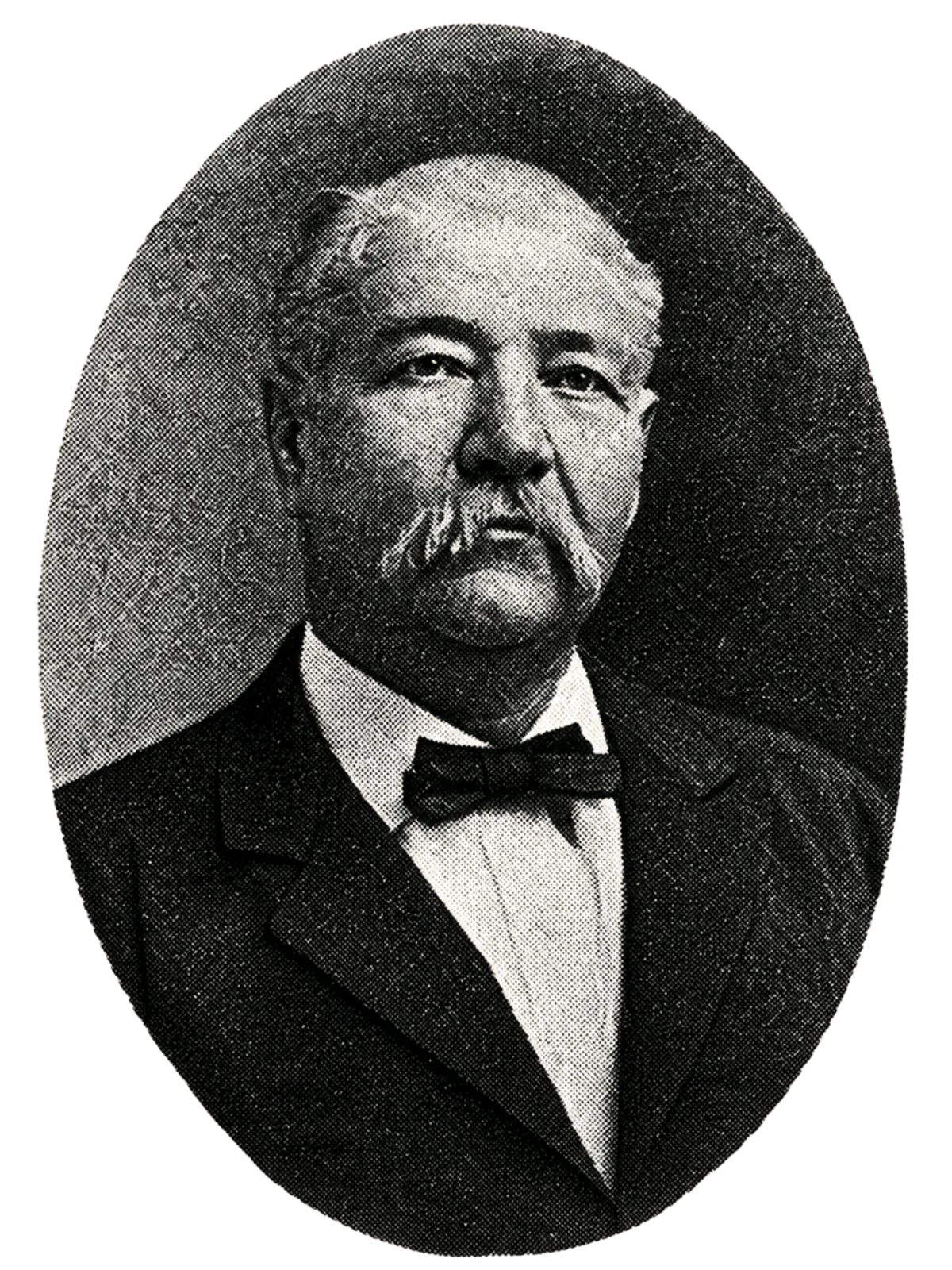
Charter Member W. S. Dugat
Elder, Lawyer, Prominent Beevillian

Charter Member John W. Flournoy
Elder, School Teacher, Lawyer, Bank President, Member State Legislature
It was laymen like these that helped to lead the Church during the early years. They, along with Charter Member J.C. Crisp (picture unavailable) and the other twenty-three hardy souls, held steadfast "To the Glory of God".
Almost a year later, the members decided that they needed to build their very own church to serve the needs of the congregation. At the time of decision, there was not a dollar in the treasury, but undaunted, they proceeded.
Rev. Laird became an architect almost overnight, and he did a great deal of the carpentry work himself. W. S. Dugat was dispatched as building committee chairman. The first thing he thought which needed done was to find a location and purchase a lot. He negotiated with B. Mattingly and purchased a lot on the corner of Walton and St. Mary's. Price $175.00. This original site was seventy by one hundred sixty-nine feet.
Meantime, during this hard-working period, Rev. Laird built a two-story home to be used as a manse. In regard to the church, everyone could see things developing slowly but they knew that it was going forward.
All church members proudly took part in seeing that the small frame church became a reality. Donations, labor, and materials took some time. Later, the pulpit and pulpit chairs were donated anonymously.
Henry Ruffner Laird was a tired architect, carpenter, and building superintendent, but a most happy and proud minister. The First Presbyterian Church now had its own sanctuary. This initial small building was to serve the congregation well from 1892 to 1921, when at that time it was enlarged.
1897 came, and Rev. Laird was to give up his work in Beeville. It was with great reluctance that the members saw him leave, never to return.
We will be grateful forever to this able pioneer minister. He was the founder of the church. With unbounded love he had nursed it from the beginning -- a small church in both membership and material means. At any rate, he left and continued his ministry elsewhere, no doubt reflecting many fond thoughts, on more than one occasion, about Beeville through the passing of years. Rev. Laird was not to pass away until 1925.
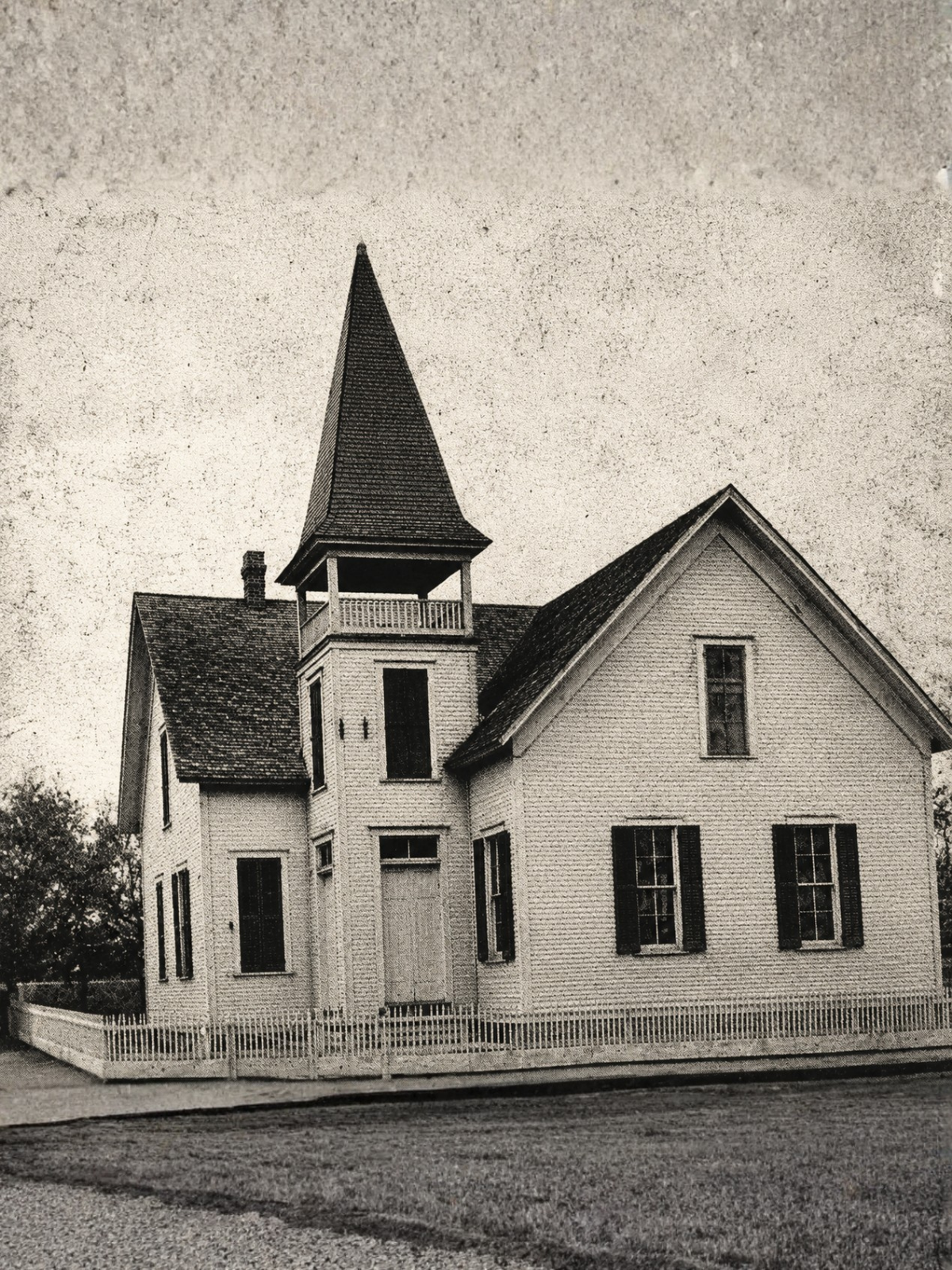
As The World Greets A New Century, First Presbyterian Continues To Establish Identity
When the Twentieth Century arrived the church was nine years old. Babe Ruth was five. James Jefferies had just won the Heavyweight Boxing Crown. Theodore Roosevelt was, at age 42, the youngest President ever elected to the office. Great Britain enjoyed unparalleled preeminence during the continuing reign of Queen Victoria.
The church pastor at the beginning of the new Century was S. M. Luckett from Sherman, Texas. He had succeeded Rev. Laird. Our church continued its growth. Evangelists and Ministers of the Gospel had always found, and continued to find, a haven of rest for body and soul when coming to town. This was especially true at the home of Mr. and Mrs. W. S. Dugat.
It was during this period, a manse was purchased. The women's auxiliary played a tremendous part in furnishing the manse. The ladies pursued the usual trend of work. They planned dinners, suppers, teas and concerts - all designed as means to furnish the church as well as the manse.
The W. S. Dugat family were all talented musicians and they contributed many colorful moments of entertainment. The eldest daughter, Estelle, was the very first church organist.
So it was truly "To the Glory of God" that the First Presbyterian Church of Beeville made its way through the beginnings of the Twentieth Century.
While the nation adventured in colonialism with the Spanish-American War, Presbyterian Churches in the United States enjoyed a positive steady growth. This, of course, included the church in Beeville.
And so, the First Presbyterian Church of Beeville, Texas — which had started its spiraling course through history when initially founded in 1891 with but twenty six members — and grown to slightly better than sixty persons during the dawning years of this new century — continued its persistent but positive growth.
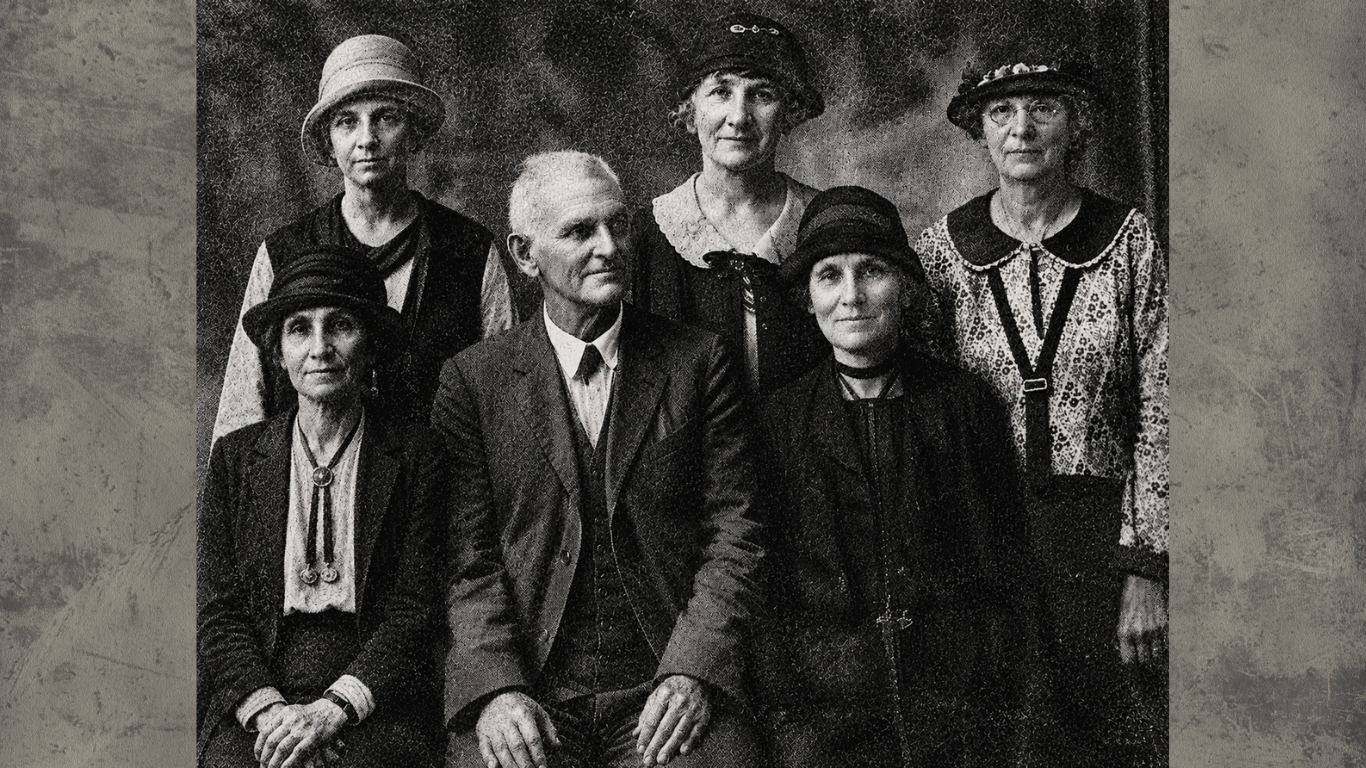
Six early members - five were charter members: back row, left to right, Lottie Bickford, Mrs. Me. E. Brauer, Estelle Dugat; front row, left to right, Molie Irwin, Judge J. C. Beasley, Mrs. W. S. Dugat.
Steady Growth Begins To Show In Spiritual Abundance
It was now 1904; Rev. Luckett had left in 1902. L. E. Selfridge was now the preacher. It was 1904, and total communicants climbed to seventy-five as reported in extensive minutes of a session meeting during the year. The pastor's salary at the time was $439.85 per year. The church had three Elders and three Deacons.
The general condition of the church was recorded in the April 8, 1904 annual report:
The following assessment was made of the church:
1. We cannot report as good attendance upon the services of the sanctuary as we would like. The morning service is fairly well attended, but the night service and the prayer meeting are very poorly attended; but perhaps one-fourth of our membership attend the two last named services.
2. Again we regret to report a dire neglect of family worship. About 15% of our families observe it.
3. The Lord's day is well observed by the majority of our members.
4. Our children are taught the scriptures and Catechisms of our church in the Sabbath School, but they are not generally taught at home.
5. Our people contribute liberally to the maintenance of the Gospel at home and abroad.
6. Our pastor has been paid promptly the 1st of each month. There was due him March 31st, one month's salary, which will be paid.
7. We have no special evidence of spiritual life and activity.
All Presbyterian Churches submit their reports to Presbytery. One Southern Presbyterian Church had stated in its report, "A few of our members indulge in card playing (we trust for amusement only); others enjoy the whirling dance, and still others attend the Opera, but the instances are the exception and not the rule."
After Pastor L. E. Selfridge relinquished his position in 1904, the church awaited the new clergyman — Rev. Leonard Thurston Gill.
Rev. Gill was born and raised in Bridgenoth, England. After early studies in Gloucester, he eventually found his way to the United States. His travel ended in Texas where he attended the University of Texas. His stay in Beeville was from July 2, 1905 until December 9, 1906.
1907 arrived, and the world became much smaller — more people, the automobile began to bring us closer. News traveled faster. Many people did not like all these fast changes taking place. There were petitions in some cities circulated to protest paving of streets with either asphalt or brick.
Two little fellows — from two diverse sections of the country, one a mid-western Nebraska boy; the other a street-wise New York City youth, both destined to become legends in the entertainment world, Fred Astaire and James Cagney, were now seven. Thomas Edison continued his amazing inventions.
A Period of Consistency — Thirty-Four Years
It was during this period, E. H. Hudson became pastor. His tenure began on March 10, 1907. He eventually served as pastor for a longer time than anyone prior or since. He left, sixteen years, nine months later, on November 25, 1923.
It is interesting to learn that the church became a pillar of stability within the community. For better than the next thirty-four years, the church was served by only three men (Hudson, Cunningham, and Hill). This represents more than one/third of the One Hundred Years of existence.
When Rev. Hudson came to us, Bee County had nearly 7,500 people. The population was to nearly double during these steadfast years of church life. Many eventful moments of both joy and sadness were to occur during these next thirty-plus years.
During this era, four milestones affecting this church took place:
It was during 1921 that the church was enlarged some sixteen feet and entirely re-papered at a cost of $1500.
In 1924 an eight room frame home was built west of the church building. This served as home of the Sunday School, the Women of the Church and the social functions of the church.
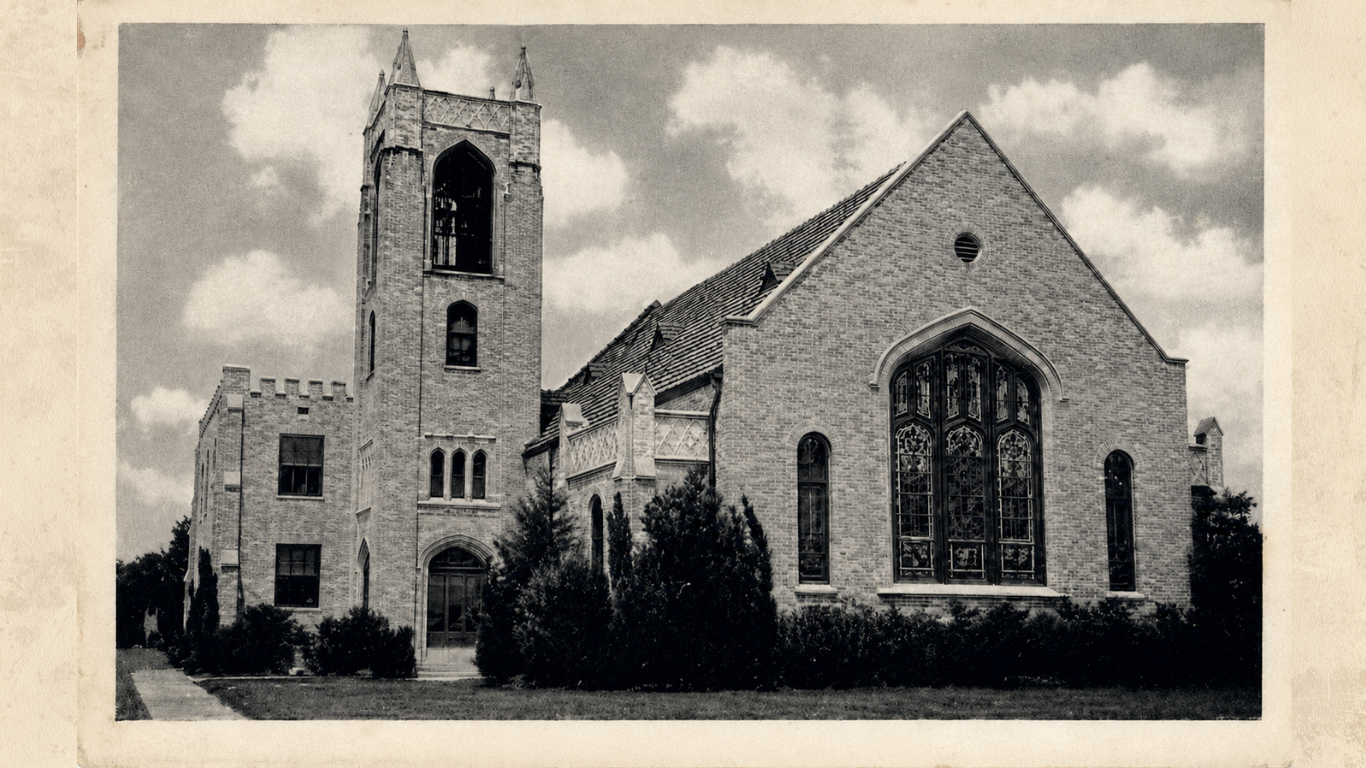
The cornerstone for the present sanctuary was laid on July 24, 1928 and the building was officially completed and dedicated in January of '29 with the first service held on the 13th.
The fourth milestone was the great depression years during the thirties. People all over the country were cold, hungry, and out of work. It was a trying period.
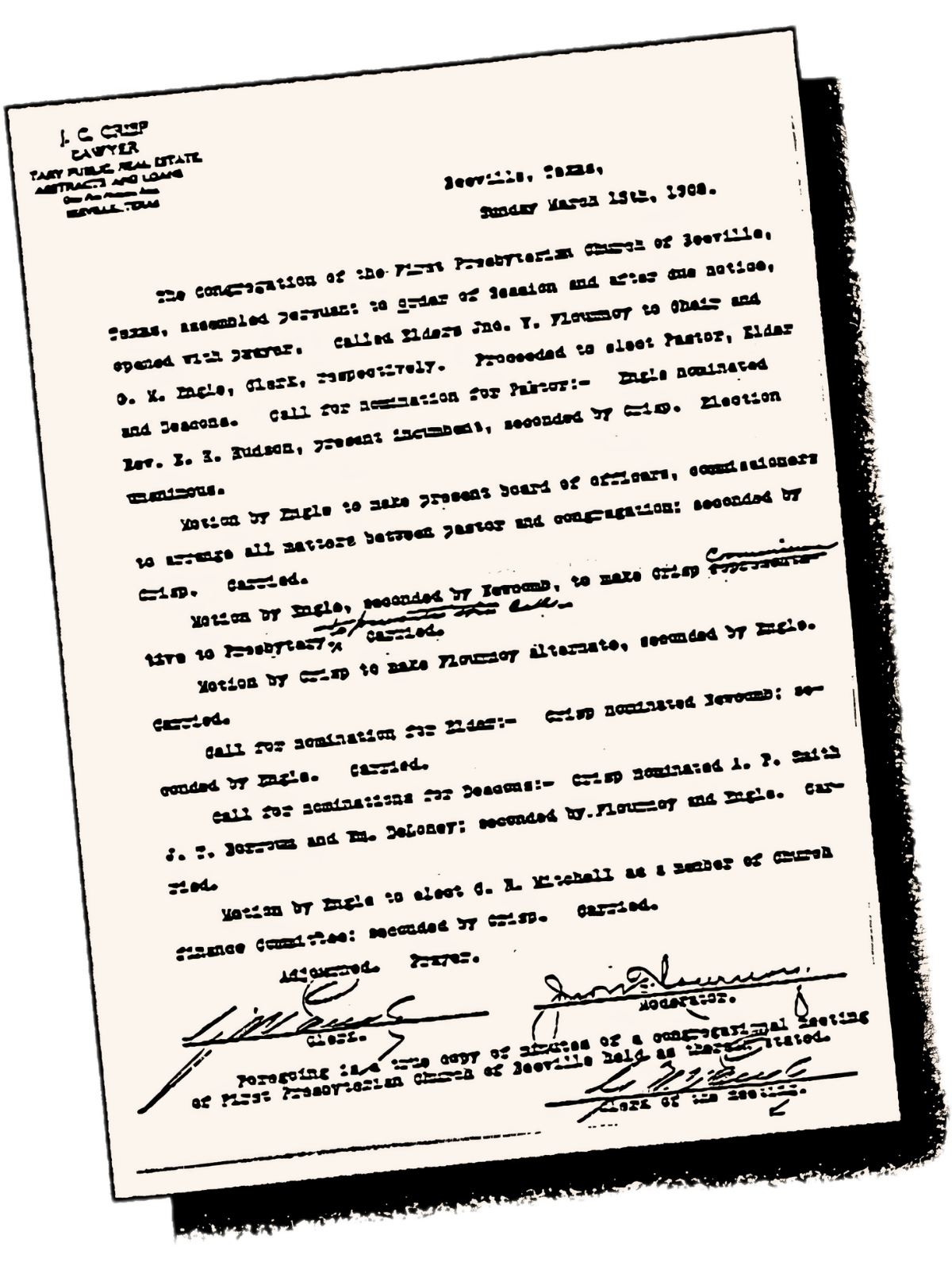
Minutes of congregational meeting — March 15, 1908. Stationary of Charter member Elder J.C. Crisp. Crisp was one of the early devoted leaders of the church.
At any rate, Rev. Hudson was a mild, hard-working individual who took Beeville and the Presbyterian Church to his heart. After a short time, his mother moved to Beeville to be with her son. This proved to be a great inspiration to him as well as the entire church family. His mother became very active in all phases of the church life. Pastor Hudson married a Beeville woman, Ethel Brown, in 1914. Both of their children were born here. After his stay in Beeville, Rev. Hudson served at Mexia, Texas, for a number of years and, upon retiring, returned to Beeville in 1941. He died at age 74 in 1946.
At a point in 1921, the session met and made plans for improvement and enlargement of the church building. Then, a congregation meeting was scheduled to select a committee to formulate a program of action and award contracts.
In addition, they began the task of raising monies for the extension. The way it worked out, the men furnished funds for the exterior and the women — the interior.
As stated previously, the entire cost was $1500 — a very handsome sum in 1921. The church now had about 175 communicants. Before leaving our story of Rev. Hudson, it should be pointed out that he gave part of his time to the Tuleta Presbyterian Church.
A time came for Rev. Hudson and his wife to leave Beeville, and it was with great sorrow and reluctance that we gave him up. This was the man that had served the congregation untiring for so many years. The fact that he came back, after retirement, to spend his last years in Beeville, speaks for itself.
1924-1934
Following a six month time without a minister, the church was overjoyed to finally welcome Rev. H. N. Cunningham. The church was still continuing a period of growth with Rev. Cunningham. In order to accommodate the ever increasing Sunday School attendance, another building was added to the church lawn. This additional building was to cost $4500.
Ideas toward the building of a new church surfaced and became the dominant concern of the members. During 1927, Mrs. J. W. Flournoy, the widow of charter member John W. Flournoy, offered $15,000 toward the building of a new church. Estimated costs were near $50,000.
In brief, it appeared that raising the additional money could not be done. Mrs. Flournoy gave an additional $5,000. The committee and church members launched the project with Rev. H. N. Cunningham, W. H. Miller and J. R. Scott named as the building committee. Every communicant, nearly two hundred now, took part with most generous gifts. As told, the cornerstone was laid on July 24, 1928. Rev. J. W. Skinner, President of Tex-Mex, delivered the address. The present church building was completed and officially opened with its first services on January 13, 1929. Rev. Cunningham's father, also a minister, occupied the pulpit for both morning and evening services. He was Rev. J. N. Cunningham of Waskom, Texas.
The church opening ceremony was said to be a most beautiful event.
A description of the church: The main auditorium seats over two hundred and by using the overhead sliding doors of the Sunday School room, this can be increased for many more. The scenery, when entering the church, is very beautiful. There is a soft glow of concealed lights. The choir has twenty-nine seats. The first organist in the new sanctuary was Miss Willie Bell. Pipes are in a room to the right of the pulpit and the blower on the opposite side.
There are seven stained glass windows in the church, exquisitely done and dedicated to E. B. Hall, W. R. Marsh, Rev. H. R. Laird, Mr. and Mrs. Max Brauer, Rissa Burrows Malone and Mr. and Mrs. W. S. Dugat. The large window behind the pulpit and choir, titled "The Lord is My Shepherd", showing the figure of Jesus with a number of sheep, including two lambs in his arms, is in memory of charter member, John W. Flournoy. It was given to Mrs. Flournoy by church members in honor of her husband.
Much credit must be given to Rev. H. N. Cunningham for he stayed with this church project constantly to see that every detail of the plan was carried out. Many of the conveniences which were built into the church were thought out by Rev. Cunningham. W. H. Miller, serving as Chairman of the building committee, worked hand in hand with Rev. Cunningham and the other committee member, J. R. Scott.
Mrs. J. W. (Gussie) Flournoy passed away on June 14, 1932. She had received her desire to see the new church built during her lifetime. In her will, she gave $2,000 to the Sunday School and $7,500 to be used in purchase of church chimes. She also gave to West Texas Presbytery. In addition, the Flournoy home was given to the church. She had given much in every way - not only in financial support, but everlasting love and friendship.
Rev. Cunningham finished his service to the church in June of 1934. Again, with heavy heart, the congregation felt the pain of departure of a fine minister who had served through some tempestuous times and depressed years, and yet, saw the building of our present sanctuary.
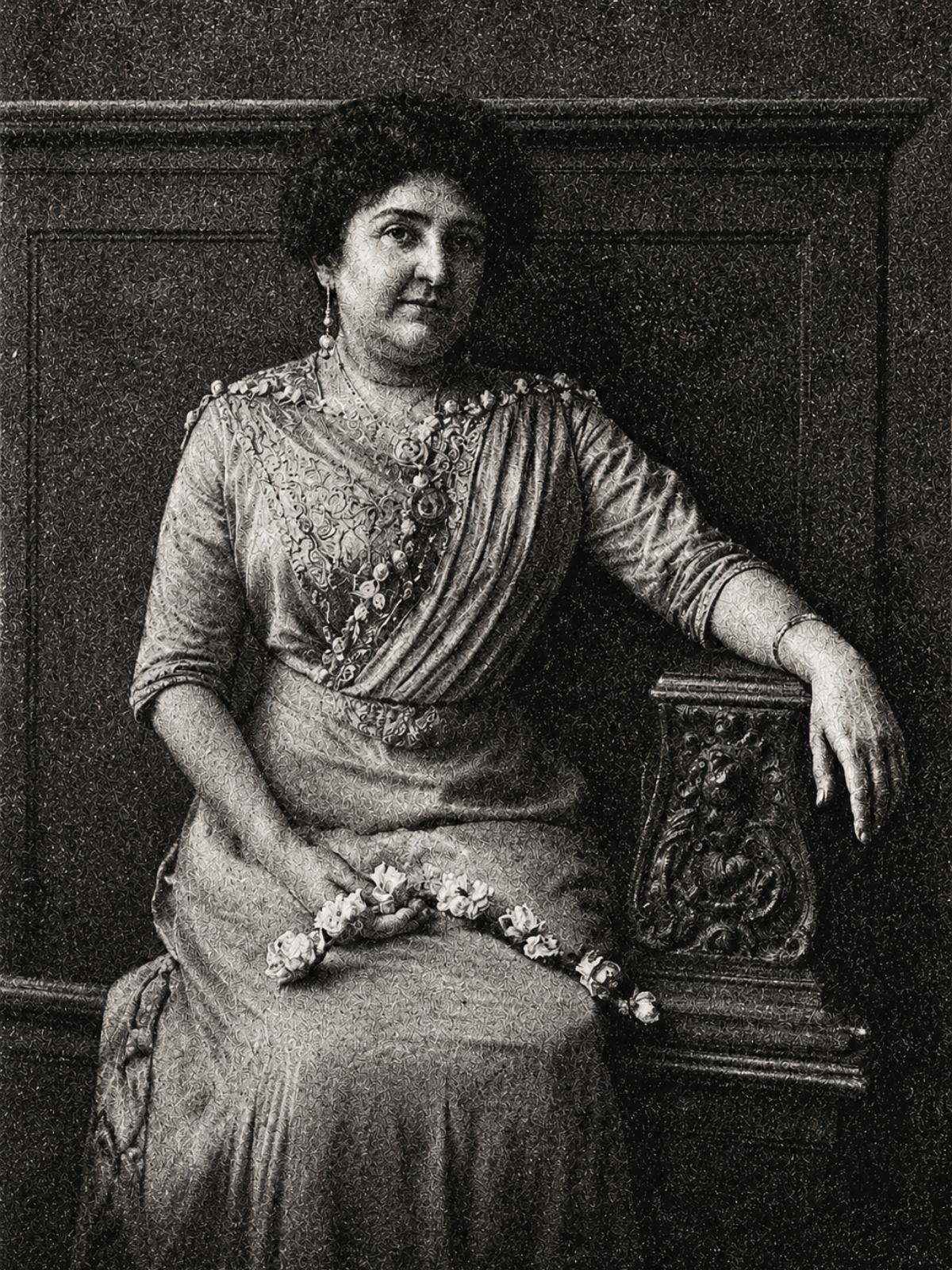
Mrs. J. W. Flournoy
A New Beginning
A new beginning could be the coined phrase as Rev. Sam B. Hill took up the gauntlet to replace Rev. H. N. Cunningham. He arrived September 1st of 1934.
Hill was a lanky-framed, 6'4", fellow with only two years previous preaching experience. Yet, he was the right man in the right place at the right time.
Yet it turned out, here was a town wrestling with low economic conditions, not knowing where to go next. Smack in the midst of the years of catastrophic depression. Bad crops—poor cattle—reflect - no money. Yet one great financial turnabout was already beginning to loom… OIL… OIL… OIL...
Sam Hill, a native Virginian, thrived on it all...he was a friend to all and soon was known by everyone through out the county and surrounding area. All denominations and church people of every faith knew him well. His sermons and ability to preach were acknowledged by all. He was undeniably one of the most forceful and eloquent speakers in South Texas. He had an amazing understanding of mankind. Rev. Hill said, "No matter how rough a man's exterior, you can always learn from him."
Later during his tenure, speakers were installed at several downtown pool hall establishments. Purpose — to carry his Sunday sermons.
Hill was an expert horseman. He worked with the ranchers on many occasions and was at ease with everyone and spoke fluent Spanish. Sunday school attendance and programs flourished as children and teenagers alike were drawn to him. The Church now has something like two hundred-ninety communicants. Rev. Hill was featured speaker at functions throughout Beeville and surrounding towns. A person felt that they could call on Sam Hill for need at any hour, no matter what church affiliation.
The shadow of U.S. involvement in World War II loomed ominously in early 1941. It had seemed so distant at one time, but now thoughts of war were ever so close. It was at this time that Sam Hill received a call to a church in Victoria. He had been pastor in Beeville for six years, nine months, but was now leaving. After his departure May 18, 1941, the church began to search to secure a new pastor. For only the third time in better than thirty-four years, the church had lost a dear caring preacher. A new one was to come in several months.
He was Rev. Marshall W Doggett. He arrived for service on September 1, 1941.
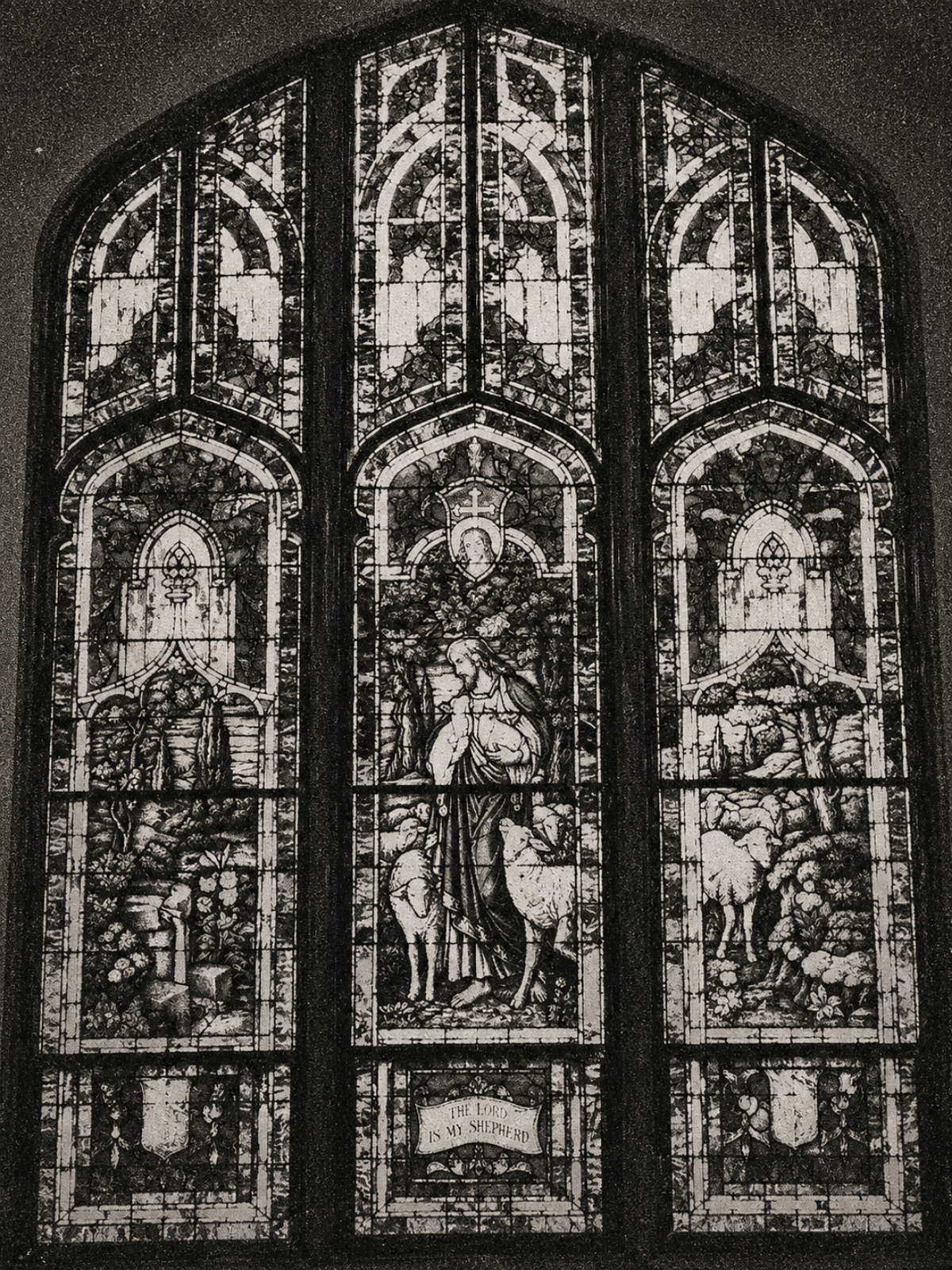
Large window behind pulpit titled “The Lord is My Shepherd”
Window given in memory of John W. Flournoy
World War 2 Calls First Presbyterian Young Adults To Service
December 7, 1941, the day that will live in infamy, brought the war to every home in our church. Suddenly, many of the bright young men in Beeville were gone...or would soon be. Many were in training at points throughout the country. Even former pastor Sam Hill had already entered the service. Some young women in the county answered the call of their country. Everyone felt the need to work hard and save our resources — "We would do all that is needed to be done to win the war and bring back our boys safely."
He was Rev. Marshall W. Doggett. He arrived for service on September 1, 1941.
In a little over one year, Rev. Doggett himself answered a call to duty. He left the church October 21, 1942.
Thus another void was to take part within the life of the Church. The members knew in advance that it was coming and thus with ample time were prepared for his leaving — and a new preacher was in place to serve when the time came for Rev. Doggett to depart.
During his short time in Beeville, Rev. Doggett had accumulated many valuable friends in the community and brought much love and serenity to the flock of the Presbyterian Church. He went immediately into the service and served with distinction.
October 28, 1942, this was the date of the first sermon delivered by Rev. Perry Paden Dawson. He had come to Beeville from Livingston and New Willard, Texas where he served for fourteen years.
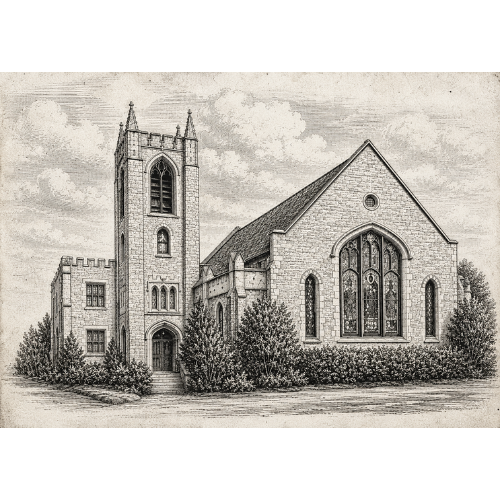
Rev. Dawson was to serve through the distressing war years and was not to leave until some five years later. It was during early 1946 that the church purchased two original premises. It was known as the Clayton property.
Also, during the Rev. Dawson period, the Beeville Mexican Presbyterian Church was dedicated, their debt paid off and the mortgage burned. In addition, the manse in the next block was sold, and the Flournoy home was sold. Our church sustained some hurricane damage, but was completely covered by insurance. On July 1, 1946, Chase Field which had been in use with pride during the war was put on caretaker basis. Many of the servicemen and women, even as today, who were either stationed here or passed through Beeville have been a vital part of the Presbyterian Church life. Rev. Dawson accepted a call to Angleton, Texas and his leaving brought a new search for a minister.
1946-1978
Rev. Wilber J. Coleman (W.J.) was called on September 19, 1946 and began his pastorship on September 29. It was destined to continue for some ten years.
W. J. Coleman was born on April 23, 1900 in Cherokee County, North Carolina. He graduated from Louisville Seminary and married Margaret Smith of Livingston, Alabama two days before Christmas in 1929. He had been serving churches in Alabama just prior to their marriage which was held in York, Alabama. Rev. Coleman served churches in Coatopa, Linden and Faunsdale; however, his very first pastorate was in Livingston, Alabama.
Mrs. Coleman, a recent college graduate, had majored in music and studied to be a concert pianist, worked hand in hand with the new bridegroom to build a beautiful Christian home and foundation. They moved to Midland, Texas in 1931 where he became Pastor of the Presbyterian Church. Both daughters, Margaret Bell (Peggy Sugarek) and Rebecca Joan, were born in Midland. It was during his tenure in Midland that a new church was built. From there he served in Bonham, Texas for better than a year and then enlisted in the U.S. Army. Chaplain Coleman served for five years throughout the Pacific and went to Japan with the occupation forces.
After discharge from the Army, Rev. Coleman returned to Cuba, Alabama where his wife and family had been living during the war years.
It was at this point that he entertained several pastoral calls. Presbyterian churches in Houston, Kansas City and Beeville. Former Pastor Sam Hill had told him not to accept any call until he checked on Beeville. This was done. He liked it immediately and accepted the call.
Rev. Coleman was destined to be a most calming and needed influence on the lives of the communicants. Mrs. Coleman and daughters were a most welcome addition to the congregation. All were very active. Peggy was an excellent vocalist and pianist and organist. It became clear that an abundance of outstanding holiday and Christmas meetings were to take on a special new meaning for everyone — young and old. Rev. Coleman was President of the Rotary Club and active in local civic organizations. It was during this period that the current Sunday School wing was built at the Church and fellowship hall remodeled.
After his tenure in Beeville, Rev. Coleman went to Premont where after five years, he retired and moved to Beeville to make his permanent home. He and his wife are both well and active now.
The Church made a call in February of 1957 to Rev. Joseph A. McGehee of Fordyce, Arkansas. He immediately accepted and arrived with his wife and children on March 20. As a gesture of welcome, members of the church had placed many wonderful choices of food in the icebox and pantry of the manse.
His first sermon was delivered on March 24th and on April 4th, a reception, honoring the pastor and family, was given by the Church.
Rev. McGehee had tremendous warmth and immediately became a friend to all. The Church continued to flourish and gain in prestige and size.
A Baptismal Fount was presented to the Church by Mrs. W. H. Miller and family in memory of her husband W. H. Miller, who had been a long-time elder and dedicated worker, having served as Clerk of the Session, Secretary-Treasurer of the Sunday School, and Chairman of the Building Committee when the church was built in 1928.
During Rev. McGehee's tenure new collection plates, a new pulpit Bible, and additional bread plates were purchased. More young adults were needed as workers in the Church and this became a reality. Activities for young people which had been instigated during Rev. Coleman's tenure, were enthusiastically embellished. A committee was formed to discover the needs and interests of young adults and to plan programs and activities that fill them.
The church continued successfully to be a hub of extraordinary activity. These were happy church times just as the communicants of past years enjoyed the closeness of Presbyterian church life. However, in the fall of 1963 Rev. McGehee resigned and moved to another church. A new search committee was formed and it was time to persistently seek a new church minister. The group consisted of Randolph Sugarek, Chairman; J.T. Hall, Jimmy Millikin, Sid Malone, Mrs. A.C. Jones and Mrs. Ruth Davis.
For a short period of time the pulpit was filled by students and teachers of Austin Theological Seminary while the committee diligently sifted through names, spent time in study and made several sojourns. On July 19 of 1964 the name of Charles R. Galbraith was presented. He was at the time Assistant Pastor of First Presbyterian Church in Lubbock, Texas. The congregation voted unanimously to issue a call to him. Rev. Galbraith accepted and was to assume his duties on September 1st.
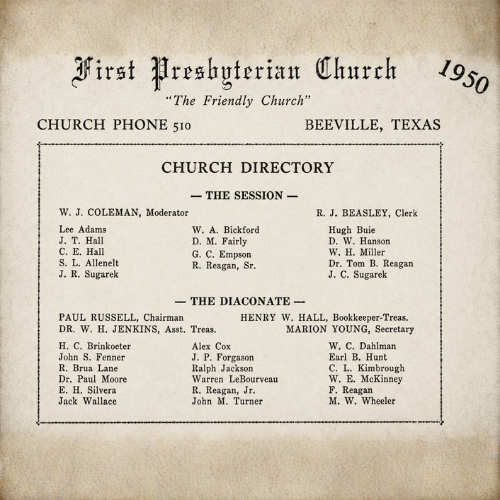
Rev. and Mrs. Galbraith (Wilma) brought a continued wave of energetic life and vitality to, not only the community, but to the church. Their four children were immediately absorbed into public school life and all church activities.
He had received his Bachelor of Arts Degree from Austin College in Sherman and Bachelor of Divinity Degree at Austin Presbyterian Seminary. He had also served as Pastor of the church at Donna.
Galbraith was an excellent speaker and a marvelous musician and gifted vocalist who added many inspirational moments on song to the congregation.
It was during this period that both Estelle Dugat and Camille Dugat were named life members of the Women of the Church. At any rate, October 4, 1964 was the installation date for Rev. Charles Galbraith. It was a most happy and joyous occasion for the membership of the Church...when the new pastor was installed.
Beginning on January 9, 1966, two morning services were held instead of the regular 11:00 a.m. service. Times were 8:30 a.m. and 11:00 a.m. There was to be no more evening services on Sunday. The women of the church taped the early services and passed them on to the ill and shut-ins.
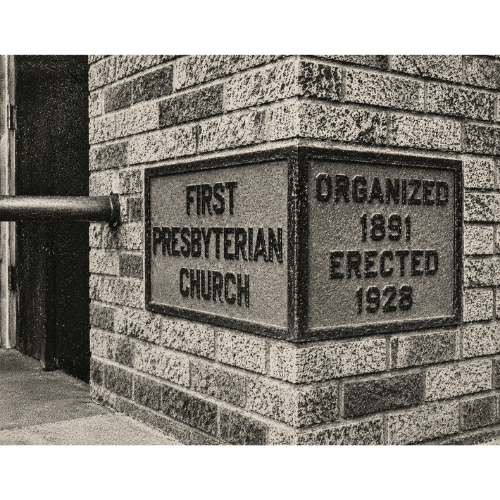
Progress in the service of the Lord continued throughout the entire six and one-half years that Rev. Galbraith was with us. However, time soon came when he would leave much too soon. He accepted a call to the Grace Presbyterian Church in Corpus Christi where he is now in his twentieth year.
Rev. Don Cureton came to Beeville on November 1, 1971 and was installed as our Pastor on November 7th. Ministers from Refugio, Goliad, Corpus Christi and Victoria, as well as, Elders J.W. Turner, W.K. Pagel and James R. Millikin, took part in the ceremonies.
During Rev. Cureton's tenure the present Church office building and meeting room was built. It is used also for activities. As Beeville itself slowly grew, the Church continued its spiritual growth. Rev. Cureton left in 1975 and Rev. Lonnie Duvall was installed as pastor on February 29, 1976. Church Elders Marion Young, Robert Beasley and John Turner took part in the installation services. His Pastorate ended in 1978. He is now a counselor at Lake Jackson.
1979-1988
A Search Committee had been organized in October of '78 and in June of 1979 they presented the name of Rev. George Stewart. The search committee was made up of Warren LeBourveau, Blackstone Dilworth, Mrs. John Fenner, Mrs. Sid Rossow and Edward Sugarek.
At that time Rev. Stewart was pastor of the First Presbyterian Church of Magnolia, Arkansas. It was a hot August day, the 16th, that Rev. Stewart and his family which consisted of a wife and two children, (Richard and Katy, who still live in Beeville and is a member of the church. Richard is on the staff at MoRanch) moved into the church manse. His first sermon was delivered on August 19th. Installation ceremonies were held on October 21st.
At the period of arrival in Beeville, Rev. George Stewart was a young man of 46. He was born in Ft. Worth and his wife Dana was born in the Rio Grande Valley. He has spent time at the University of Texas where he received his B.A. Degree. It was at the Austin Presbytery Seminary that he received both B.D. and M.D. degrees. His very first Pastorate was in Henderson, Texas where he served for three years. (1960-1963)
Other Pastorates were Sonora and Alamo Heights of San Antonio. During his tenure in Beeville, Rev. Stewart continued taking various self-improvement courses in religious and related fields, such as: Council of Sensitivity Training Lab at MoRanch and Basic Psychiatric Seminar at University of Arkansas Medical School.
A director of Christian Education was added to the staff of the Church. She was Nancy F. Smith. She came to us on July 1, 1980. Miss Smith was from Hampton, Virginia and received her Bachelor Degree from Westminister Choir College in Princeton, New Jersey, and her Masters Degree in Christian Education from the Presbyterian School of Christian Education in Richmond, Virginia. She had begun her career as a certified Presbyterian Church U.S. Educator in 1964. Miss Smith was a talented young woman who presented many inventive ideas to the church.
During the tenure of Rev. George Stewart, the church had four memorable eventful transitions:
1. Our first DCE - Nancy Smith
2. Developing of the Vineyard (A joint venture of the Presbyterian, Lutheran, Methodist, Catholic and Episcopal churches.)
3. The new organ
4. Historical Marker
Rev. Stewart accepted a call to The Presbyterian Church in Del Rio and left at the first of the year in 1988. The outstanding former Refugio Pastor, Rev. Joe Wright served as Interim Pastor from January 17 until December 31, 1988. Our DCE, Nancy Smith, left in May of 1988.
New Pipe Organ For The Church
A new Pipe organ for the Presbyterian Church was made possible by Memorial Gifts to the Church over a long period of years. This, together, with a portion of the bequest from the estate of the late Henry W. Bell of Brownsville. Mr. Bell had always admired the playing of the organ by Mrs. Floy Beasley. The new chimes were given in memory of Mr. and Mrs. James Scott by Mr. and Mrs. Sid I. Malone. This organ was built and installed by John T. Fort of Dallas, Texas. It was a custom Pipe Organ with 1300 pipes and 25 chimes. The organ is a thing of beauty and unmatched in sound. The organ was dedicated on November 3, 1980.
Reverend David Gallaher Accepts Call To First Presbyterian Church
Rev. David Gallaher and his wife, Shirley, came to Beeville from Pine Bluff, Arkansas. He was pastor at the Presbyterian Church in Pine Bluff for some twelve years and prior to that time was at the church in Edinburg for nine years.
Gallaher and his wife immediately blended into the Beeville life and atmosphere making friends, from the start, throughout the entire area. Gallaher, a tall 110% Irishman hails originally from Calgary, Canada. A gentleman in the true sense of the meaning, he affably fits into the scene wherever he goes. He attended college in Spokane, Washington and in Austin, Texas at the Presbyterian Theological Seminary. Rev. Gallaher was ordained in June of 1964. He has made trips to Scotland for the American Summer Institutes at St. Andrews and also to Rome to the Waldensian Seminary.
Rev. Gallaher is a marvelous teacher of religion and an outstanding minister. He has developed strong friendships everywhere and is always available for everyone in the church.
Wherever they have been, Shirley Gallaher has been most active in the church. At present she teaches Sunday School and blends her beautiful soprano voice into the choir.
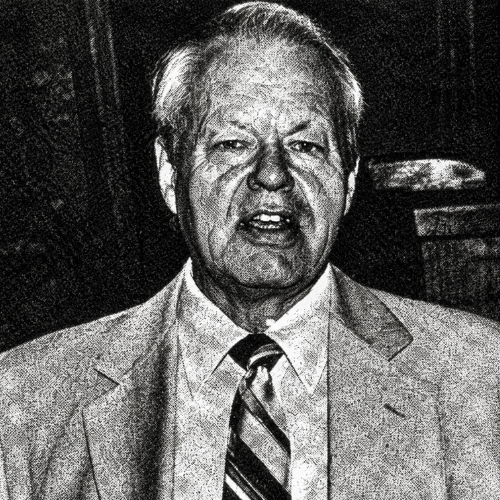
Rev. David Gallaher was installed as our Pastor on November 6, 1988.
In addition, she has always been thoughtful in caring for the elderly. They have two sons, Kelley and Regan.
Rev. Gallaher works hard in the community to see that a spiritual bounty is harvested in Beeville. During his tenure to date, the church has continued with its growth; new pews have been installed in the church along with new carpet and new song books have been added to the library. Our church is most active and is a visible refuge for searching souls. Our Wednesday night suppers are a complete joy and as our church moves into the dawnings of its second one-hundred years — we are in most capable hands.
A Century of Music
Music has always played a powerful part in the worship and program of The First Presbyterian Church of Beeville. Leadership by more than competent choir directors and men and women have blessed this congregation through the past one hundred years. The Choir Director at the present, Everett McAuley, is a gifted musician that has developed a fine honed choir that is second to none in the surrounding area. He is a remarkable pianist and organist in his own right. The church organist is Orleane Megason who adds much continuity, with her musical skill, to the Sunday Services.
The very first organist of this church was Estelle Dugat, Charter member and daughter of Mr. and Mrs. W. S. Dugat who were also charter members of this church, and she served in the capacity for more than thirty years. As noted, all the early Dugat family were very musically inclined and one would suspect that all were part of the early choir.
During these early years Presbyterians enjoyed open air concerts furnished by the Dugat family orchestra. They were held on the Dugat family lawn at which time ice cream and cake were for sale. This was a way to make money for the church. Camille Dugat played the guitar; Estelle was at the piano, and other members of the family played harp, violin, and mandolin. Somehow Estelle Dugat served as Choir Director along with playing the Church Organ. Estelle Dugat passed away December 11, 1974 at age 103 and was the last remaining Charter member of the church.
Records reveal that Miss Willie Bell became organist for the church right after Estelle Dugat turned over the reins. This was to be about 1922. She was to continue for nearly ten years. Willie Bell was a lovely gifted musician who was dedicated to serving the Lord. She was the organist of this church at the time of dedication of the present sanctuary on January 13, 1929. The church had a pipe organ at the time which was presented by Mr. and Mrs. J.S. Hall Sr. Mrs. Floy Beasley became organist in 1931.
No mention of anything musically about this church could be made without taking note of the very dear Floy Beasley. Anyone that came in contact with this woman came away with knowledge that they were in the company of a wonderfully gifted person and a true child of God. Mrs. Beasley served as Church Organist for better than forty years. She retired in January of '71.
Everett McAuley became Church organist at this time and he has worn many hats since then.
Together Mrs. R. J. Beasley and Estelle Dugat served a total of close to seventy-five years as Church Organists. When Willie Bell's service of ten years is added, it makes a total of 85 years. There is few, if any churches anywhere that could conjure up this kind of record. We, as a church member, and Beevillians as a whole, have experienced a great void with the loss of these women who gave of their love and time. They shall be remembered forever as great contributors in the history of the church.
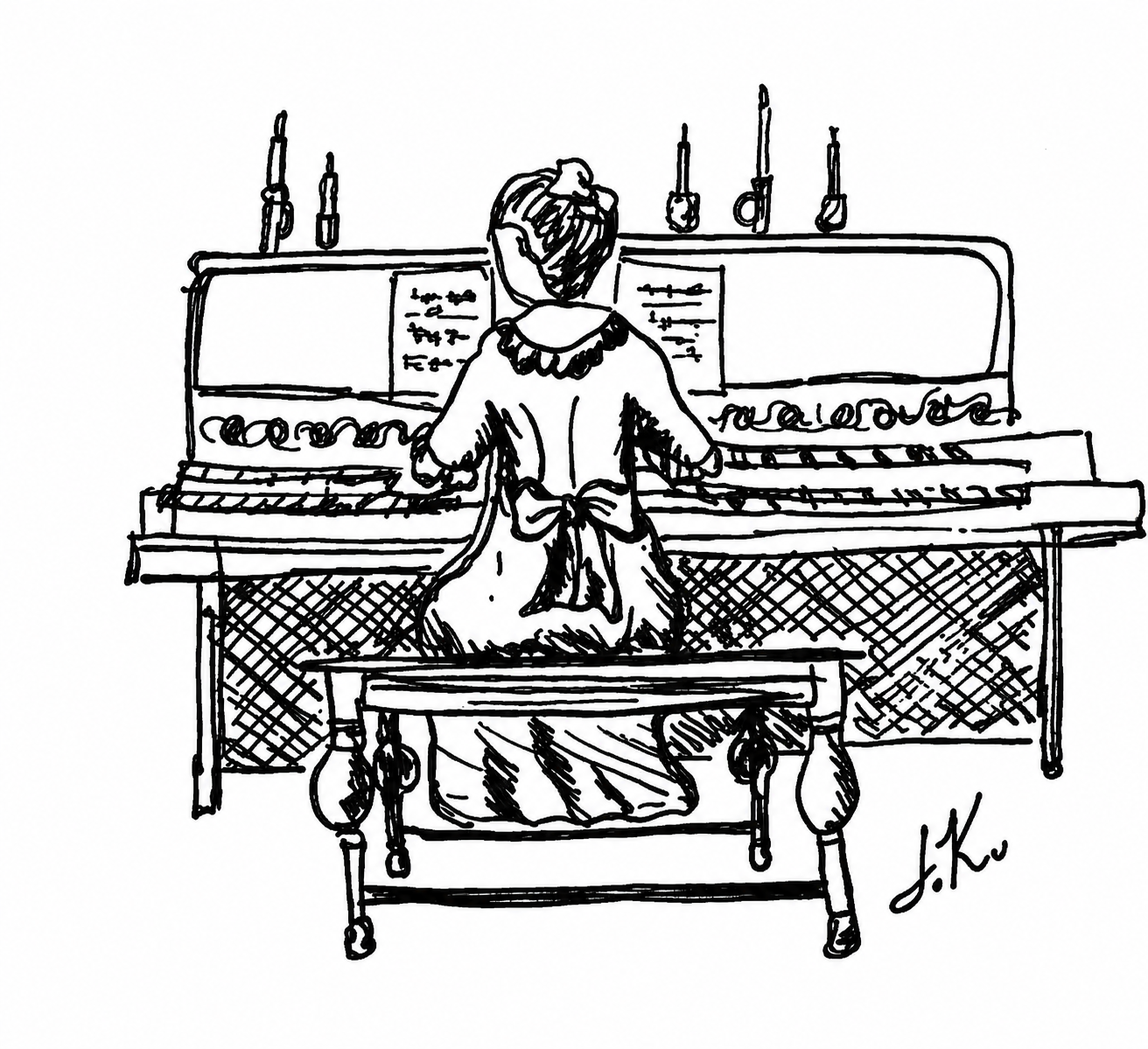
There have been so many names of distinction that have completely riveted the attention...of everyone. Not enough space or time can recount the dedicated musical people that have blessed this church. Much of the music sung reflects their exuberance and energy in singing praise to the Lord. These are the ones, then, that make this love of God and love of music contagious infecting the entire congregation.
Names like Polly Fenner, who served as a Choir Director; Margaret Coleman, Pianist and organist; Peggy Sugarek, Choir Director, Organist and soloist. Some of the others who gave of their talents and time, many of who still sing in the Choir — names like Hugh Buie, Lee Archer, Camille Dugat, W.S. Dugat, Bruce Sugarek, Allen Sugarek, Edward Sugarek, Mrs. Wallace McKinney, Mr. Bell and Mrs. J. C. Burrows who sang in the choir for some forty-five years. Lucy Moore, Elizabeth Millikin, Mrs. M.G. Irwin, Ann Nicolson, and many others. One cannot forget Dot Wade and her contribution to the music.
Two remarkable talents served as soloists, along with many others. They were Sid Malone and Dorothy Brown. Both could have carved out a fine professional musical career. Sid Malone served as Choir Director for thirty-three years and still sings in the choir. Dorothy Brown and Sid Malone were both in demand for weddings and programs throughout the area.
The complete listing of those who have served as church organists during these one hundred years are Estelle Dugat, Miss Cecelia Brauer, Miss George Offut, Camille Dugat, Mrs. J.C. Dougherty, Miss Willie Bell, Mrs. Robert Utter, Mrs. R.J. Beasley, Everett McAuley, and Orleane Megason.
A Brief History Of Troop #200 Boys Scouts of America
In the fall of 1941 a small group of boys approached Marion Young with the proposition of forming a Boy Scout Troop. Although Young was only 36 at the time, he told them he was too old. They needed to see if they couldn't get a younger man. A few days later the boys returned saying that they could not find anyone. They talked Young into becoming scout master.
Now it became necessary to get a sponsoring institution. The men of the Presbyterian Church were selected but they refused saying it would cost too much. Young assured them it would never cost them a cent and it never did.
Henry Hall gave the Troop Flag and the American Flag. In addition - he furnished all the scribe books. Next, they sought a charter and began a search to recruit more boys. the Troop grew until it had sixty boys at its peak. This troop lasted for twenty-five years and has become part of the history of the church.
All boys were required to advance, to attend church and learn to pray. All meetings were opened with a prayer by one of the boys, Pledge of Allegiance to the Flag, and recitation of the Scout Oath and Laws. Cursing and use of bad language was not permitted and strictly enforced by the boys themselves.
The troop went to annual summer camp at Indian Creek Scout Camp at Hunt, Texas. The boys worked as a troop on projects to earn money to pay the fee. There were boys that could not afford the fee and were against solicitation of funds for anything, the scouts did.
We were deeply indebted to Homer Wise who had a vegetable stand and sold Christmas Trees. He turned the sale of the trees over to the troop and we made enough money that every boy was able to go to Camp. In fact, the most boys that went to camp at one time was fourty-four. Sometimes the leaders of scouts from other troops couldn't take their boys to camp so we took them with us.
Leaders who attended camp with Young were Uncle Ben Nash, Rex West, Robert Beasley and Sam Pieper. The troop was also indebted to Dean Miller of Lagarto; Holman Cartwright of Dinera; Dick Scott of Beeville and Leonard Smith of Oakville - - all of whom made their ranches available to the troop for camping.
In l966, Young overheard the boys say "that old man is not going to take us camping again". Young decided to give the Men of the Church six months to get another Scoutmaster which they did not do and that was the end of the wonderful association with the Boy Scouts of America.
Presbyterian Women
Throughout the years the Women of the Church have gone under various names; however, at the present they are known as Presbyterian Women. No matter the name, when it pertains to the growth of the Church in Beeville and its surge forward throughout the illustrious century, there is nothing to compare with the strong consistent harmony of the women of the church. Their forthright decisions, matched equally by their working results, have been a remarkable achievement.
It may be said, with conviction, that the women never wavered, nor shrinked from a project. There would not be enough time nor space to provide the names of all those loving souls who, by their diligent activities, formed the backbone of this sanctuary.
No one can forget the many socials, teas, bake sales, cookie sales, musical programs, cook books (there were many), replacement of furniture and chairs, sewing, decorating and many other special missions — all instruments to help the church.
A story, even so brief, would not be concluded without mention of dear Gertrude Cowie who served so many years as Church Secretary. Her office, at one point, was in the little room adjacent to the Choir loft. She kept the pulse of the church and was proud of her work and rightly so. Even in cold biting winter weather, Mrs. Cowie could be found in her office, huddled near a small stove, working on church matters. In addition, she was always active in the women of the church.
Another remarkable Presbyterian woman was Mrs. A. C. (Gertrude) Jones. She, for many years, worked tirelessly with the Women of the Church. Any chore that would help the church, Mrs. Jones was right in the middle serving with charm and ease. She was always available to serve the needs of the young people and gave much of her time to all phases of the church. Many lawn parties were at her home. In looking through the records of the church, one quickly becomes aware of the many mentions of deeds done by this loving woman.
1990 Officers
Elizabeth Millikin ........................... President
Thelma Jean Smith ............................ Secretary
Ann Stark .................................... Treasurer
Annie Nicholson .............................. Historian
Ione Dyal .................................... Circle 2+ Co-Chairman
Aleene Sugarek ............................... Circle 2+ Co-Chairman
Katherine Barber ............................. Circle 4 Chairman
1991 Officers
Gail Blackmon ................................ President
Yvonne Curbo ................................. Vice-President
Thelma Jean Smith ............................ Secretary
Ann Stark .................................... Treasurer
Anne Nicholson ............................... Historian
Ann Stark .................................... Circle 2+ Chairman
Ione Dyal .................................... Co-Chairman Circle 2+
Catherine Kubenka ............................ Circle 4 Chairman
One of the steller hard-working and devoted Christian women was Mrs. J. Chrys Doughtery (Mary Virginia). She had a warmth of understanding and deeply loved her Presbyterian Church. Mrs. Doughtery was a long-time Sunday School teacher with a compassionate ability to convey God's message to persons of all ages. She was a most charming and sweet woman who was critical to the success of this church. When needed, she was available at the organ.
And there were others — many, many more. Such as Susie Reagan, who everyone said was one of the finest caring women in the world. She taught Sunday School for many years and was a joy to be around. And, of course, Mrs. W. H. Miller (Cecilia Brauer - daughter of Charter members Mr. and Mrs. Max Brauer). Mrs. Miller acted as historian for the church women for better than thirty-five years. Ann Nicholson is the current Historian.
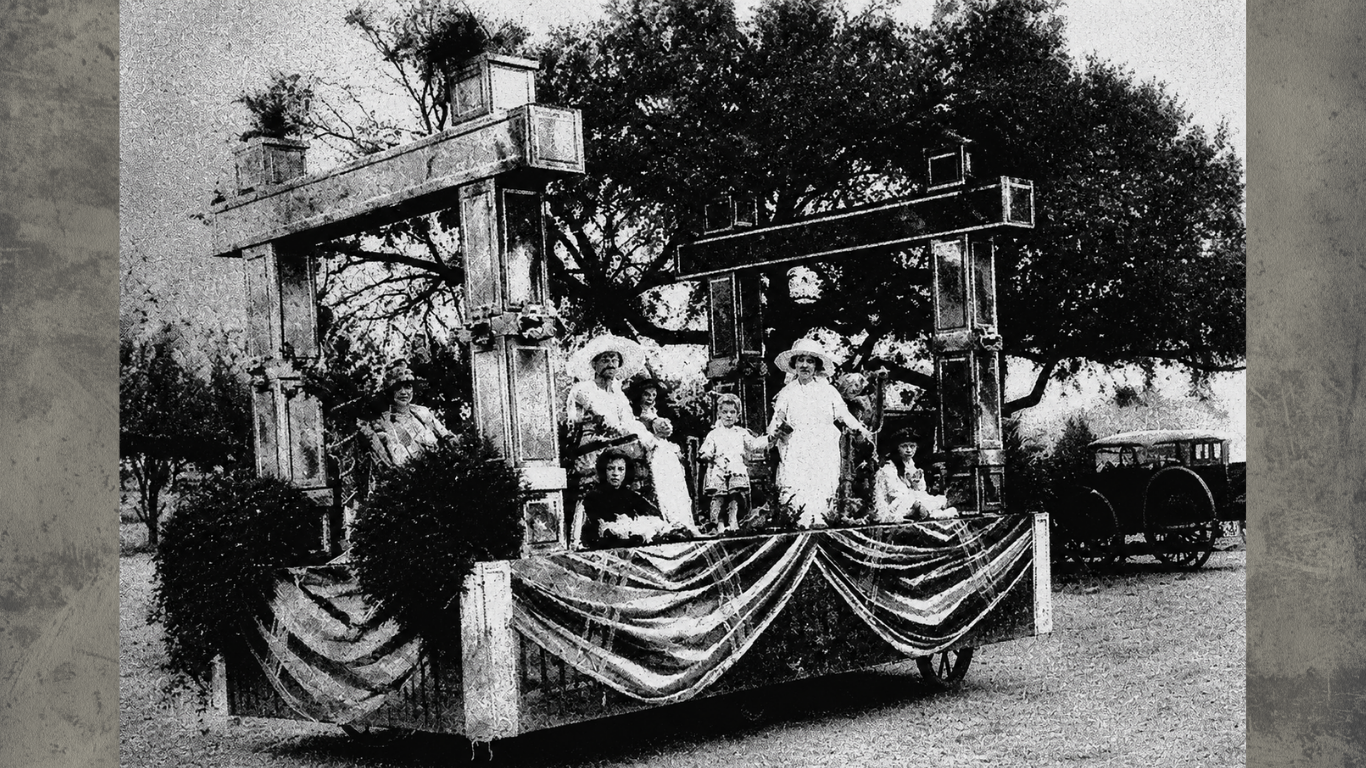
Presbyterian women and children take part in early parade. Circa-1917
The Ebenezer - Presbyterian Story
Almost as a prelude to our present time, it all began in April of 1891. It was at this period in history of the Presbytery of Western Texas that a Walter S. Scott was ordained as evangelist to the Mexican people. He was to be located in San Marcos where the first Spanish-speaking congregation of our church was organized in the year 1887.
It took strong effort and tedious perseverance but Scott organized eleven churches and aided in building five chapels in a period of ten years. His work extended from Corpus Christi to Uvalde.
In the early dawning of 1902 he was to successfully organize and develop a church in Beeville. It had fifty soul searching members. He later established a church in Clareville. In 1908, the Texas-Mexican Presbytery was set together in San Marcos and Walter Scott became its first moderator.
One can imagine the hardships and trials of those early days. The Mexican Presbyterians shared the facilities of the First Presbyterian Church. This was to continue until they were able to build their very own sanctuary. It was in 1924 that the Mexican Presbyterians of Clareville, Beeville and Olmos became merged into what was to be known as The Ebenezer Presbyterian Church.
Following Rev. Scott in the Spanish-speaking ministry was a pastor by the name of R. D. Campbell. Rev. Campbell was a devoted leader and was remembered with great esteem.
On May 18, 1941 dedication ceremonies were held for the new Ebenezer Church. Construction for the combination church and manse had begun back in the fall of 1940...but now the big day had arrived for the loving congregation.
A Rev. C.C. Acevedo was the main speaker. Additional voices were Reverend Sam B. Hill, Pastor of the First Presbyterian Church of Beeville; John R. Scott, Mrs. W. H. Miller, and several members of the congregation. Music was provided by the two Beeville Church Choirs.
Location of the Ebenezer Church was 207 West Ireland Street. The second story of the building was used as living quarters for the Rev. M.G. Garcia and his family.
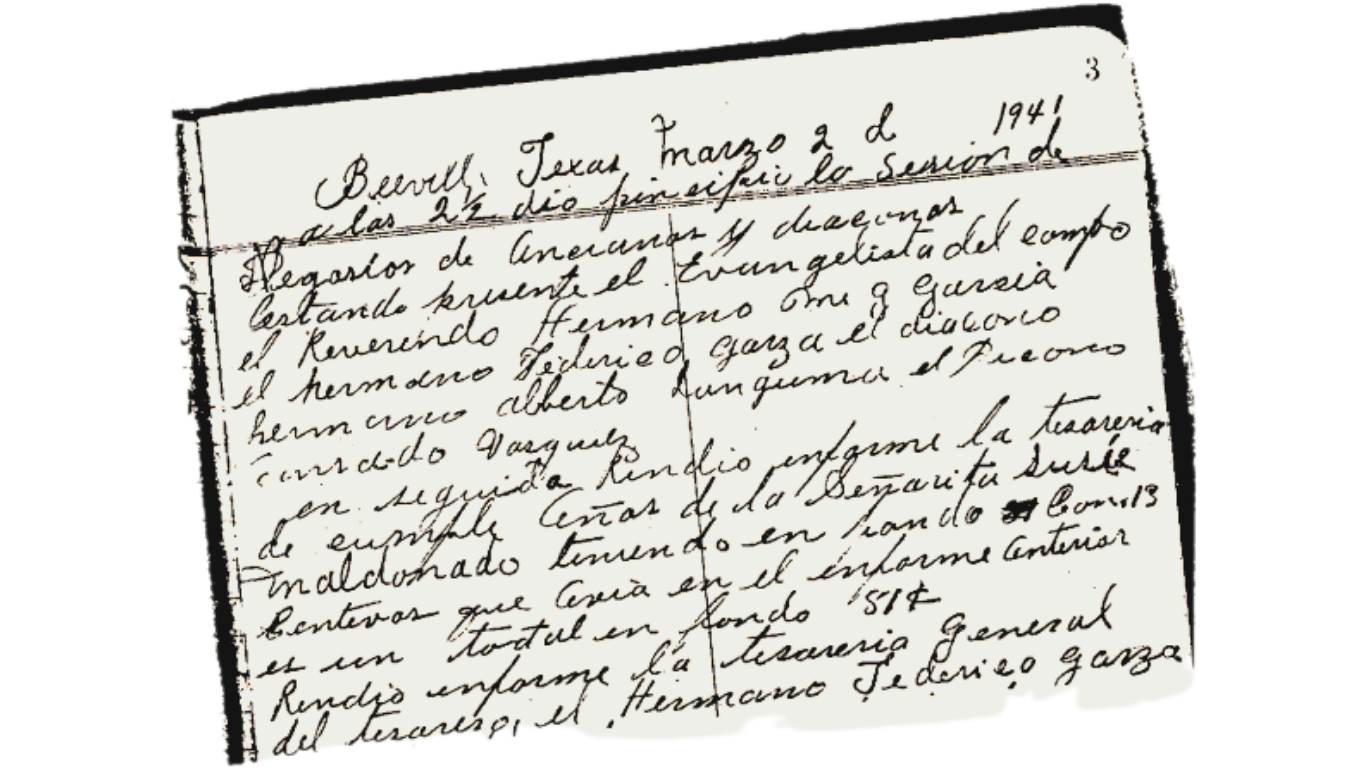
It is recorded in Church history that the Ebenezer Church was led by:
Rev. Walter Scott .......................................... 1902
Rev. R. Avila ...........................................…. 1913-1914
Rev. R. D. Campbell ....................................... 1915-1916
Rev. D. T. Torres ......................................... 1916-1920
Rev. C. C. Avevedo ........................................ 1921-1925
Rev. S. G. Ramirez ........................................ 1925-1940
Rev. Manuel Garcia ........................................ 1940-1944
Rev. Francisco Rugerio .................................... 1945-1949
Layman Mr. Pimental ....................................... 1950-1953
Rev. Jose Rojas ........................................... 1954-1957
Rev. L. C. Hernandez ...................................... 1959-1964
Rev. J. V. Franco ......................................... 1966-1967
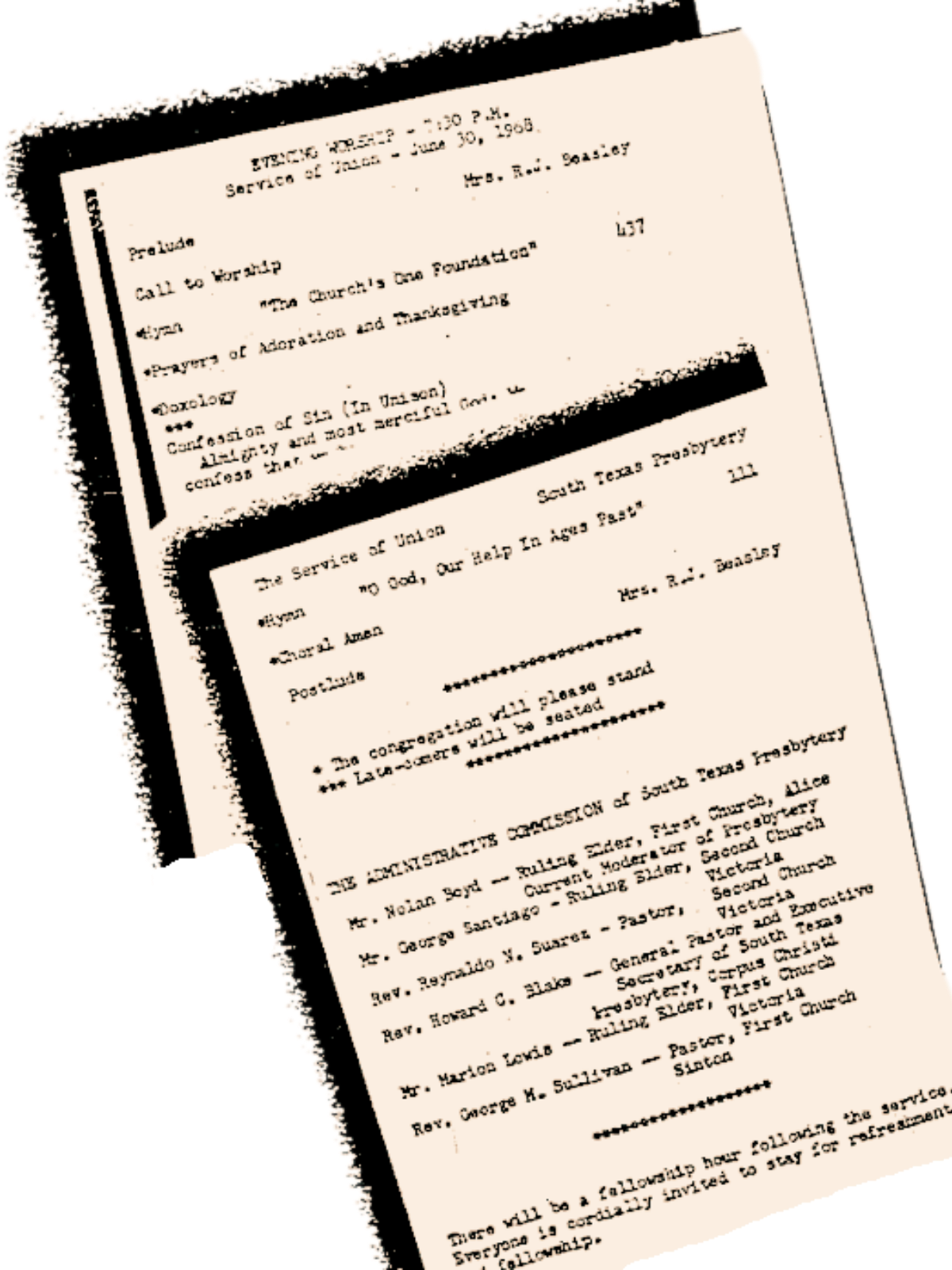
It was June 30, 1968 that the two Beeville Presbyterian Churches became as one. Congregational votes were held in both churches and the merger came into existence. Reverend Charles Galbraith was the Pastor at this stage of Church History.
Many courageous and devoted worshippers were members of the Presbyterian Ebenezer Church and a great many of those continue equally as proud in what we know to be the First Presbyterian Church of Beeville.
Centennial Committee
Officers
Jimmy Goodman ............................... Chairman
Laura Fischer ............................... Vice-Chairman
Susan Rossow ................................ Secretary
Dora Alice Garcia ........................... Assistant Secretary
Jim Millikin ................................ Treasurer
Members
Day Abel, Lee Archer, Robert Beasley, R. W. Dirks, Shirley Gallaher, Ida Frances LeBourveau, Louanne LeBourveau, Dee Pagel, Lawrence Reagan, Ruth Turner, Buncy Walden, Marion Young
Centennial Year Church History written by Jimmy Goodman
Co-chairmen Centennial Banquet - R. W. Dirks & Ruth Turner
Centennial Float Chairman - Lawrence Reagan
Centennial Banner - Shirley Gallaher
Scrapbook - Dee Pagel
Sketches - Jeannie Kesler
Boy Scout Material - Marion Young
1991 Church Staff
Dave Gallaher ................................... Pastor
Robin Dalton .................................... Secretary
Everett McAuley ................................. Choir Director
Louanne LeBourveau .............................. Handbell Choir Director
Orleane Megason ................................. Organist
Wilburta McCarley ............................... Senior Nursery Attendant
Marcos Silva .................................... Custodian
Alta Silva ...................................... Custodian
Adolfo Ramirez .................................. Custodian
Trustees
Lee Archer
R. W. Dirks
Jane Hardy
Our Centennial Float won First Place, Non-Commercial.
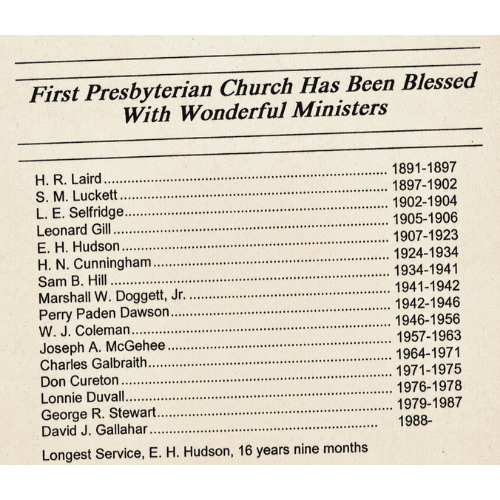
A Bronze Tablet containing all ministers for the 100 years given in memory of Mrs. A. C. (Gertrude) Jones by her family.
The cross in the sanctuary is in memory of Lucille Bell Archer given by her sister, Genelle Bell, and her son, Lee Archer.
Two members of our church went on to become Presbyterian ministers. Tom Dyal and George Klett. Reverend Klett is now pastor of the Presbyterian Church in Goliad.
Four former ministers accepted invitations to attend the One-Hundred Year Anniversary Celebration: Sam B. Hill — Charles Galbraith Joe McGehee — George Stewart
The first person to speak at the church after the new pews were installed was Chrys Doughtery.
The Baldwin Grand Piano in the sanctuary was donated on March 20, 1952 by Marilyn and Sid Malone in memory of Mrs. J. C. Burrows who sang in the church choir for a little over fifty years.
Charter member Estelle Dugat lived to be 103. She died in 1974.
Robert Beasley is the only living direct descendant of a charter member of this church.
Devoted Christian Leadership
From the very outset it was quite apparent that the flock of this church were destined to have many outstanding hard-working Christian souls who worked for their church and the community with equal zeal.
Men who are fixed to the Presbyterian Church history like genial Rocky Reagan who served in every capacity of this church. He was an Elder and long-time Sunday School Superintendent. Mr. Reagan was always available for time with the church.
W. H. Miller, Elder and Church Secretary for so many, many years, served also as Chairman of the Building Committee of the present sanctuary. Everyone knew that it would be done right with W. H. Miller at the helm.
Elder J.R. (Dick) Scott worked his heart out for his church for so many years. He also served as a moderator for Presbytery and took part in everything for the betterment of the Presbyterian Church, which he loved so very much.
Early Charter members like Elder J. C. Crisp who worked so many long hours at his office on church matters and was also named as the first Sunday School Superintendent. Elder John W. Flournoy who gave hard work with every fiber in his body as did Elder W. S. Dugat with his talented family who were so needed during the early years.
Elder Tom Brown Reagan and Elder Lonnie Borrum both gave so many hours of devotion to their church.
Elder Robert Beasley served as Clerk of the Session of this church for forty-two years...and is a most important cog of this story of the first one-hundred years.